

There is a particular kind of dread attached to the phrase “team building.” Trust falls. Icebreaker bingo. A facilitator with a lanyard asking everyone to share “one fun fact.” Somewhere along the way, Singapore’s corporate calendars decided that bonding required either physical humiliation or forced vulnerability, and neither has aged well.
Cocktail workshops solve for both problems by asking almost nothing of anyone except attention and a willingness to hold a shaker without spilling. Nobody has to trust their colleague to catch them. Nobody has to confess a childhood memory. They just have to measure, pour, and taste — which turns out to be plenty
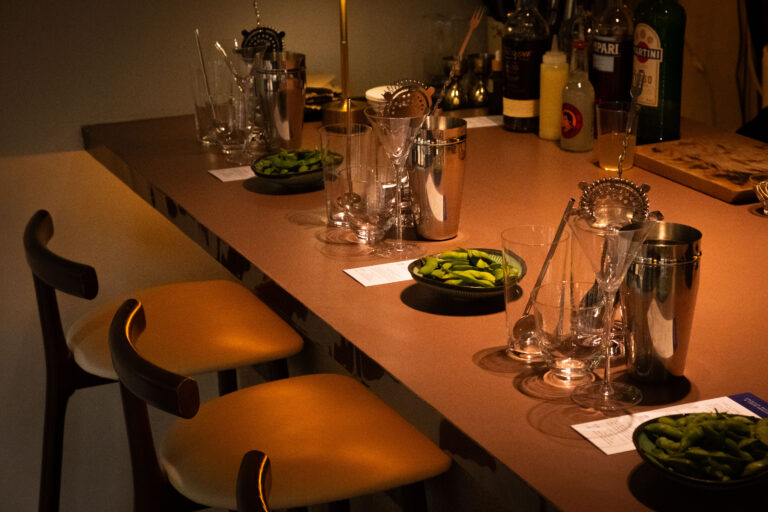
The case for shaking things up, literally
A cocktail-making session works as a team activity for reasons that have less to do with alcohol and more to do with structure. Most formats split a group into small teams, hand everyone the same base ingredients, and ask them to build something specific — a shaken drink, a stirred one, a built one — within a set number of steps. That’s a low-stakes creative brief with an immediate, tasteable result, which is a rarer thing in a typical office week than it should be.
The hierarchy-flattening effect gets mentioned often enough that it’s become a cliché in event-planner copy, but it holds up: a workshop puts the CEO and the intern on equal footing in front of the same jigger and the same instructions, and neither has home-field advantage. Debating whether a Boulevardier needs more Campari is a lower-stakes disagreement than most of what happens in a Monday planning meeting, and it still counts as practice at building something together.
Where to book one in Singapore
The Artisan Events,
hosted at Lunì – Scent, Bar & Kitchen on Lavender Street, runs its cocktail workshops with a sensory hook: participants pick a scent from a set of essential-oil-infused volcanic rocks before working with a mixologist to translate that aroma into a drink, learning to shake, stir, and build along the way. The workshops page notes sessions can run for up to 44 guests on-site, or the team can bring the format to an office instead — useful for larger departments that don’t want to relocate an entire floor. It reads less like a lecture and more like an excuse to argue about what bergamot should taste like in a glass, which is closer to actual bonding than most agendas manage.
Hopscotch Bar
has built a reputation for tailoring its cocktail workshops around a brief — past sessions have leaned into product launches and brand tie-ins, including custom menus built around a client’s colour palette. For a team that wants the workshop to double as a subtle nod to a campaign or a milestone, this is the more design-literate option.
SIPbarconcierge
runs dedicated cocktail team-building workshops with a client list that includes MNCs and government-linked companies, plus a mocktail version for teams that would rather keep the bonding sober. It’s a practical pick for HR departments that need an inclusive option without a separate booking.
The Shake Affinity
offers bartending and mixology workshops that can be set up almost anywhere — office pantry, function room, home — with tiered levels from bartending basics through to more advanced mixology, which suits a team that wants to turn this into a recurring thing rather than a one-off.
For groups weighing this against other formats, Honeycombers’ team-building round-up and Sassy Mama’s list are useful references for comparing cocktail sessions against the usual alternatives — art jamming, cooking classes, escape rooms — if a debate breaks out over what the budget should actually go toward.
What to check before booking
Pricing, minimum headcounts, and whether a venue will travel to your office all vary and change often enough that they’re worth confirming directly with the venue before locking in a date — several of the workshops above quote per-pax pricing that’s tied to group size, and off-site setups typically carry different minimums than in-house sessions. Worth flagging for anyone budgeting this against a fixed per-head allowance.
The actual argument for it
None of this requires anyone to enjoy drinking, particularly — most venues run a mocktail or non-alcoholic version alongside the standard menu. The real value is structural: a shared task with a visible outcome, low enough stakes that mistakes are funny rather than costly, and a built-in reason to talk to someone outside your usual team without anyone having to manufacture small talk about the weekend. It’s also, unlike a lot of team-building formats, something people would plausibly choose to do on their own time — which might be the simplest test of whether an activity actually bonds anyone.
